
The Niggardly Nigger - First Recording in ~150 Years!
By Harry Hunter & T. Vincent Davies, is this a 1900s coon song or a 1870s minstrel song?

This historically significant song requires considerable unpacking!
There appears to be some misconception about this work being represented on “official” sources like Wikipedia (no surprise there).
To start, the date of this work is unconfirmed. This is the first work I’ve recorded that I could not confirm the publication year (hence the “circa” 1879).
Several sources, including Wikipedia, claim it was published in England in 1900, however no sources confirm this and there are multiple reason why this is factually incorrect. Wikipedia also lists this song as an example of the “coon song” genre: https://en.wikipedia.org/wiki/Coon_song
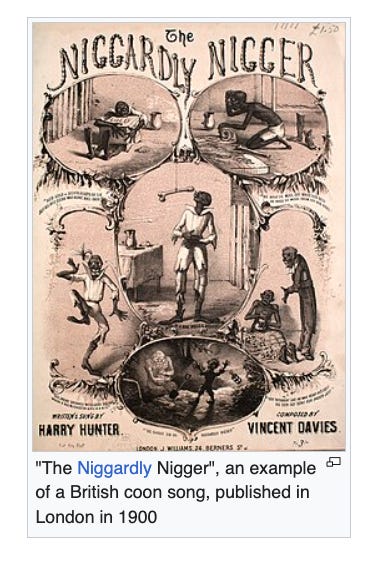
From Wikipedia: “The Niggardly Nigger, an example of a British coon song, published in London in 1900.”
The “coon song” craze really didn’t take off until the late 1880s and 1890s. From my extensive research, I haven’t found anything from the 1870s that can remotely be considered a “coon song” in the modern sense.
Instead, this is very much in the minstrel music tradition and was meant to be performed in the “Music Halls” of late 1800s Britain (The British equivalent of America’s Vaudeville): https://en.wikipedia.org/wiki/Music_hall
There is a *huge* difference between the popular music of the 1870s vs 1900. This work, by my estimation, fits perfectly with the aesthetic of the former. Older works are far less likely to have publication years, but by 1900 almost every work included the year.
The cover style that includes the story of the different verses in a collage of vignettes was also much more common in the 1860/1870s era. This went out of fashion by the 1880s (more or less).
Wikimedia has an image of the cover, and also claims the 1900 date, but provides no source: https://commons.wikimedia.org/wiki/File:Niggardly.jpg

You can *purchase* this cover on Alamy (lol don’t do that) and it lists both 1899 and 1900 as the publication year. But yet again the 1899 estimation is not sourced and inaccurate. For example, we know this song was performed as early as 1893 in England: https://www.mkheritage.org.uk/archive/parish-magazines/parishmag-hanslope.html
It was also performed in New Zealand in 1897!
https://paperspast.natlib.govt.nz/periodicals/NZT18971231.2.4.3
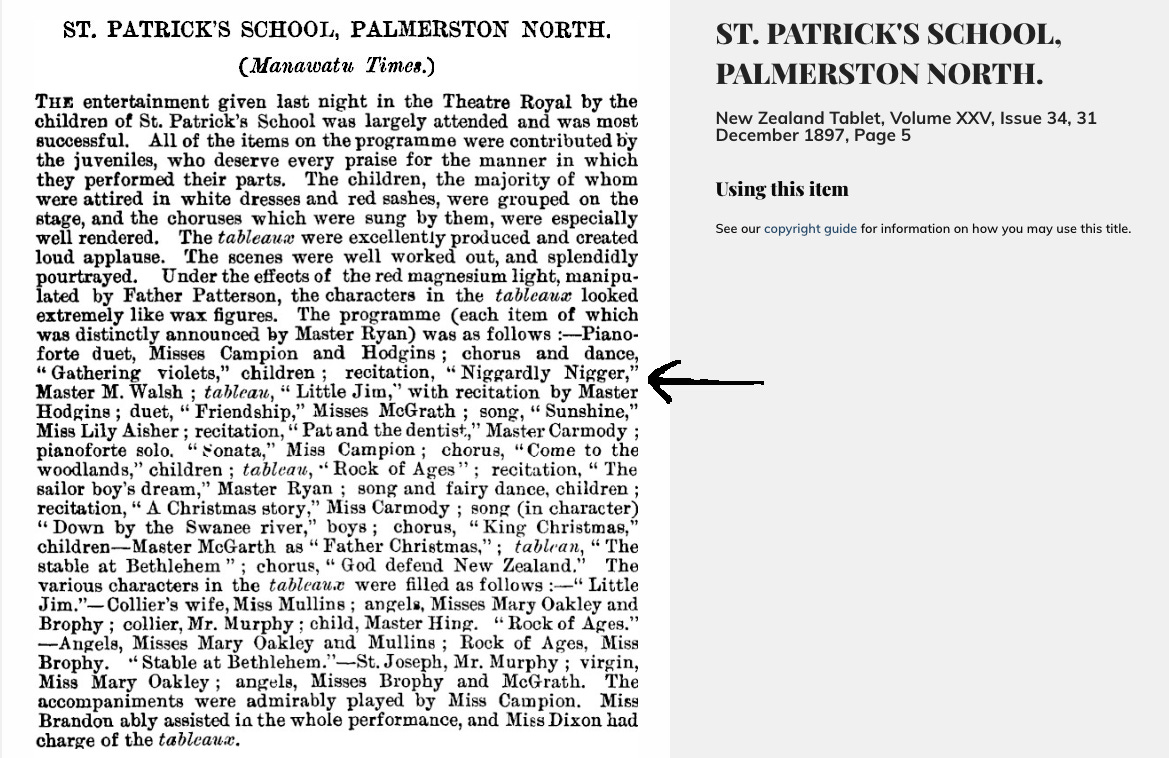
Back then it took years for songs to spread internationally so this timeline checks out with a publication date far earlier than 1900.
The FULL sheet music can be downloaded for free at the Johns Hopkins Levy Collection: https://levysheetmusic.mse.jhu.edu/collection/017/138
Note how it’s listed as “n.d.” for no date and it doesn’t mention 1900. The Levy page for composer T. Vincent Davies includes several other works: https://levysheetmusic.mse.jhu.edu/people/vincent-davies
Three of theme are “n.d.” and two others were published in 1871 and 1872. A third is included in an 1886 collection of songs, but it first was published ~1874. His IMSLP entry has only 3 songs. https://imslp.org/wiki/Category:Davies,_Vincent
He is described as a “British music hall composer” born in 1832 (no source given). His death year is unknown. The 3 works on imslp span the years 1871-1879, which matches Levy’s collection.
This website is often a great resource for information about these old composers and their work: https://www.grainger.de/music/composers/daviestv.html
This includes information about ~80 works by Davies published until the 1890s, but it’s unclear if some may have been written then or published posthumously in various collections.
This site usually pulls from primary sources and while not 100% accurate, I find it more reliable than Wikipedia etc.
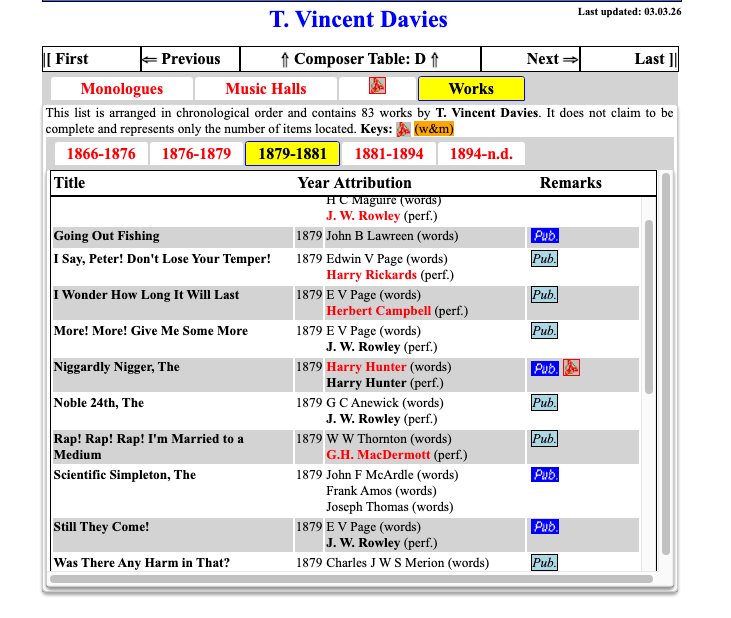
In this collection of T. Vincent Davies, the song “The Niggardly Nigger” is clearly labeled as published in 1879. Unfortunately, there is no source given for this date BUT it fits in with all my speculation about the actual decade it was written. This is why I landed on the 1879 date, but included the c. because it’s not proven. TBH, it’s possible this was written *prior* to 1879, but for now I think that date is the most accurate estimation that we have.
The Grainger site also has an entry for Harry Hunter, but the vast majority of his credits are as “performer” and sometimes as lyricist: https://grainger.de/music/composers/hunterhar.html
The Levy Collection also has several Hunter works, but most are listed as “n.d.”: https://levysheetmusic.mse.jhu.edu/people/harry-hunter
IMSLP only lists one work: https://imslp.org/wiki/Category:Hunter,_Harry
Wikipedia actually has some information about Harry Hunter, although he doesn’t have his own page. Instead, he’s mentioned on the page for British music publishing company Francis, Day & Hunter Ltd. https://en.wikipedia.org/wiki/Francis,_Day_%26_Hunter_Ltd.#

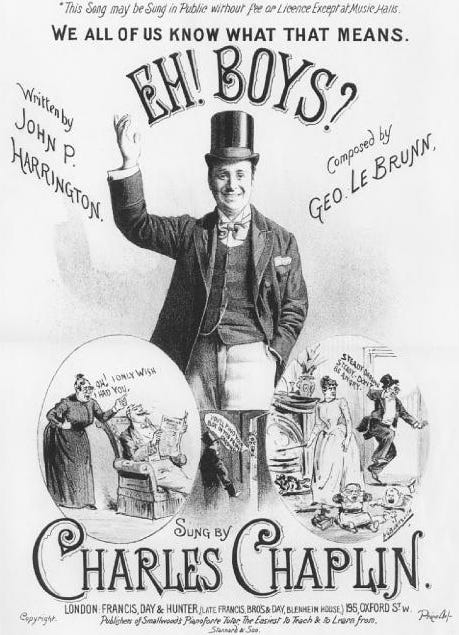
This popular and successful company published works of the stars of the British music halls, such as Charles Chaplin, Sr., the father of the famous director:
According to Wikipedia, the brothers William and James Francis were leaders of a music hall minstrel troupe in London called the Mohawk Minstrels. Harry Hunter, whose dates are listed as 1840-1906, was part of a “rival” troupe called the Manhattan Minstrels. However, they joined forces in 1874 and Hunter became a performer with the Mohawk Minstrels and the Francis brothers began publishing his songs.
In 1877, David Day (1850-1929) joined and created the Francis Bros & Day publishing company. In 1880, Harry Hunter was named as partner and his name was added.
And here we have further proof of the 1879 estimate for our song! The Niggardly Nigger is listed as published by “Francis Bro. and Day” only! IOW, Hunter had yet to be added as a partner. This means the song must have been published between 1877-1880!
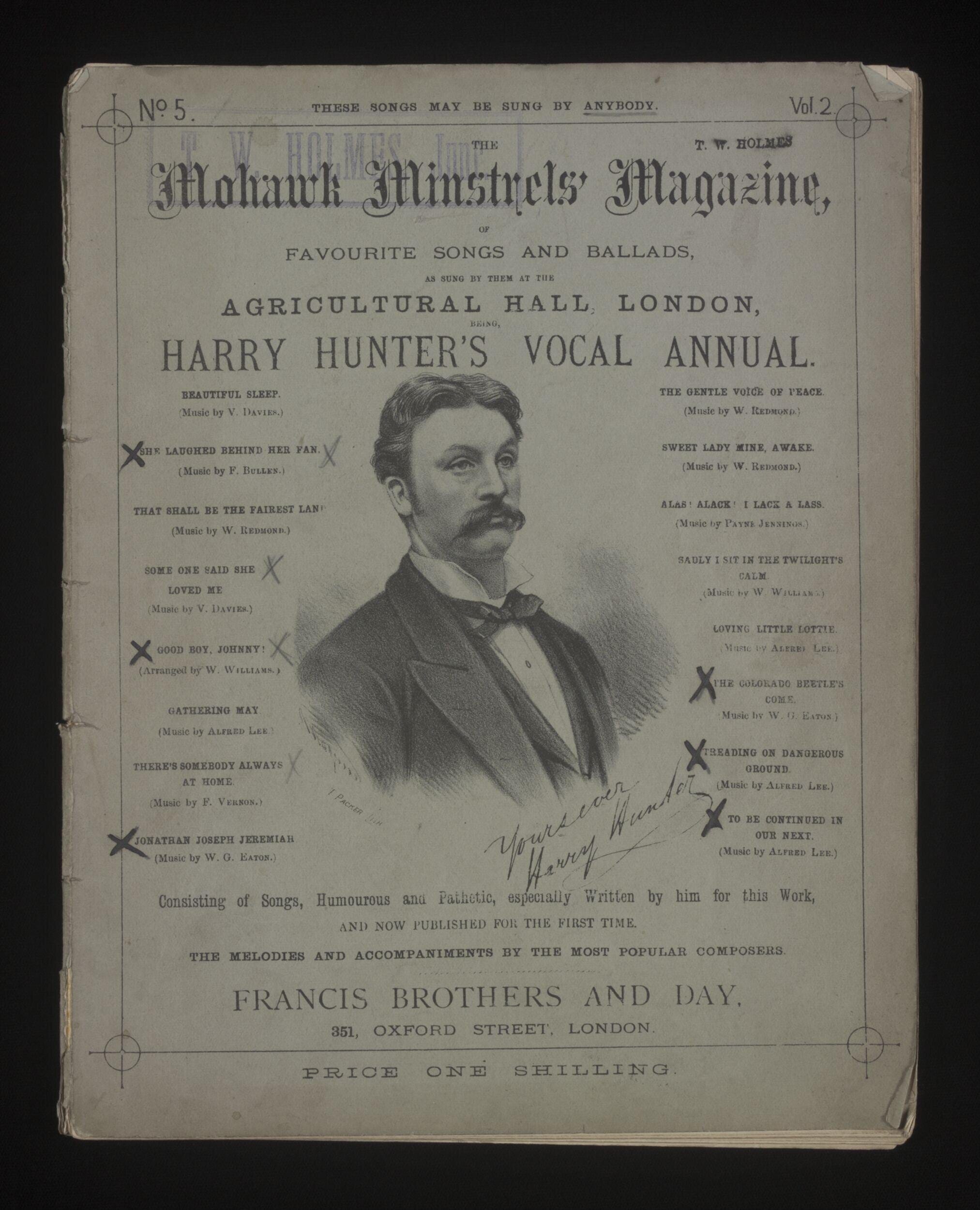
Note it also is listed as “Francis Brothers and Day” but does not appear to include The Niggardly Nigger. This seems to add credence to the 1879 estimate as perhaps that song hadn’t been published when this collection came out.
To conclude, I’m confident that 1879 is likely the correct year this was published. The 1900 date claimed by Wikipedia and other sources is wildly erroneous. The music of the 1870s compared to 1900 are different worlds. This is the world of the 1870s.
EDIT: An astute reader has discovered something! There is an advertisement for this song in 1870! This is proof that the song was written long before the claimed “1900” publication date, in fact it’s over 3 decades older than that!
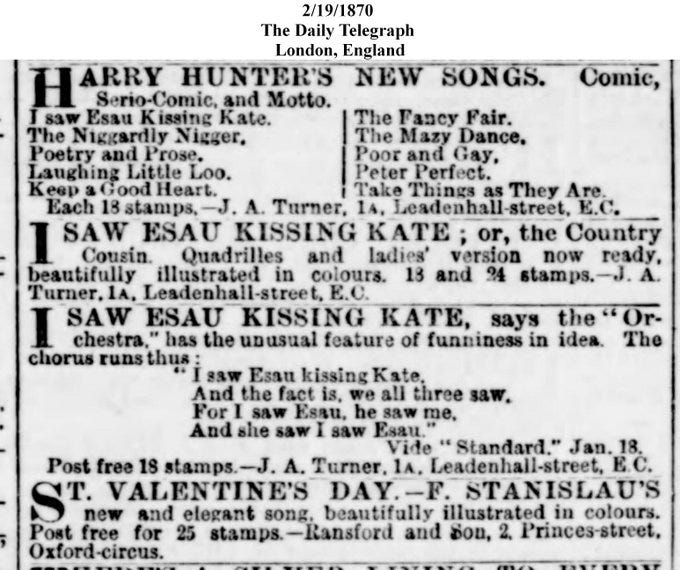
Now the version that survives in sheet music form was still published between 1877-1880 but this confirms my suspicions that this work is much older. In fact, it’s entirely likely it was written in the late 1860s! This again fits with my suspected timeline. Even 1879 sounds too “new” for this work.
I think it’s wholly remarkable that a very old song from the 1860s is being passed off as a “racist coon song” from 1900 when that’s a COMPLETE inversion of reality. When this song was written ~1870, these terms were NOT considered racial “slurs” and the context of this song is VERY different even from 1900.
This is why it’s important to study this music and properly understand the context and the era in which these songs were written.
I’ve avoided discussing the obviously racially inflammatory content and imagery until now. This type of comedic performance was very common in this era. The word “nigger” was NOT considered an offensive slur in 1870s England. It was essentially a descriptive term. This isn’t the time for an entire dissertation on the minstrel tradition and the nuances of the humor which appears egregious today, but I can say with considerable confidence that this song was not meant to be wholly malicious and racist in intent. I have circumstantial evidence to support this assertion.
Songwriter and performer Harry Hunter wrote songs sympathetic to the black cause and celebrated their freedom from slavery. Notably, he has a work published by Francis Bros & Day (so 1877-1880) called Emancipation Day:
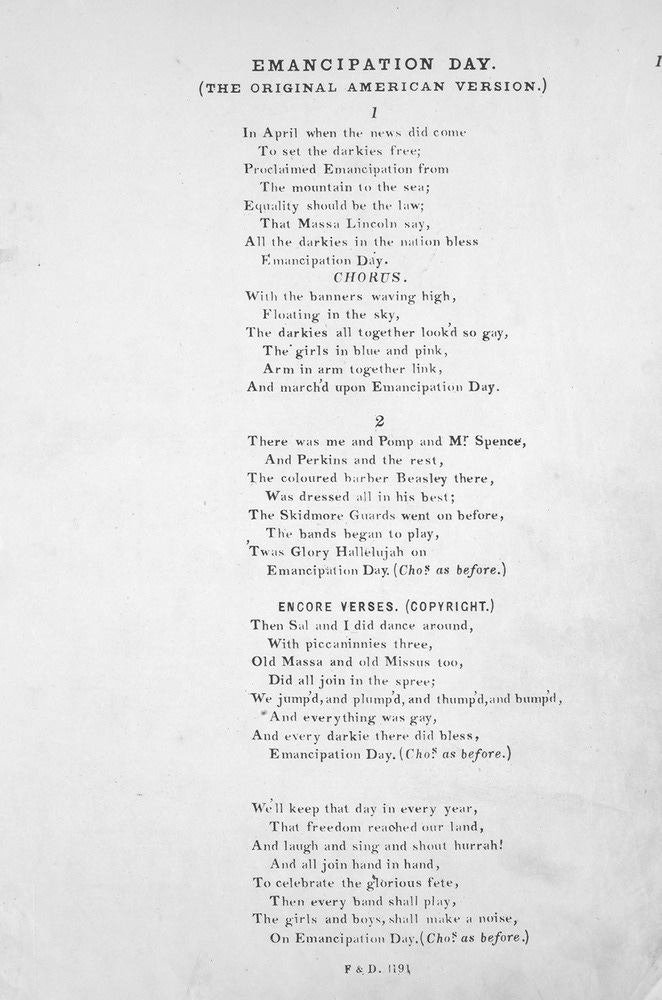
The lyrics include lines such as: “We’ll keep that day in every year, that freedom reached our land, And laugh and sing and shout hurrah! And all join hand in hand, To celebrate the glorious fete, Then every band shall play, The girls and boys, shall make a noise, on Emancipation Day.”
One of the more surprising things I’ve discovered about the minstrel performers of the 1800s is that many were *supportive* of abolition and championed the pro-black cause. They weren’t trying to be “hateful” they were just mimicking black culture for comedic and entertainment purposes, and these performances were usually enjoyed by all races. In fact, BLACK minstrel performers were wildly popular in this era as well!
IOW, in the context of 1900 London, a song like this would indeed come off as slightly distasteful (and old-fashioned!), but in the context of 1870s minstrel troupes, a very different picture emerges. The other works by Hunter are comedic or pleasant ballads, and some are even anti-racist! This song was NOT meant to be malicious, it was meant to be funny. We might find this distasteful or horrific today, but it’s very important to consider this in the time it was written. It’s not even an indictment on an entire race, it’s about one old guy who’s ridiculously miserly! The racial aspect of the song is merely the result of a silly pun.
I think that’s why it’s very good that I performed this to preserve it properly. Having it listed as a racist “coon song” from 1900 on Wikipedia paints a very inaccurate portrayal of this work and others like it. This is *not* a “coon song” and it’s certainly not from 1900! It’s a comedic minstrel song from the 1870s and reflects the humor and sentiments of that era. Hunter noted the clever similarities between the word “niggardly” and “nigger” (which have very different etymologies) and decided to write a song about it.
You could truly write a dissertation about each of these old songs! It’s a pity they have been cast aside and so thoroughly demonized. They are a window into our past, and our past is our past whether we like it or not. Thank you for reading, I appreciate it very much!
Much love, -Kylan
1870! I found mention of it in London's The Daily Telegraph in Feb. 1870. I'll tag you on Twitter with the image. I'll send two tweets since I can only send one image at a time ... one with the mention of the song & the other with the full page in the newspaper.